
A legjobb eszközök a társult vállalkozásokhoz és a forgalmi arbitrázshoz: Antidetect böngészők, proxy-k, virtuális kártyák és IP-ellenőrzők

In 2026, affiliate and traffic arbitrage is no longer just “offer + creative.” It’s a full technical stack: antidetect browsers, high‑quality proxies, virtual cards for media buying, IP checkers, trackers and automation tools.
The stronger your stack, the fewer bans, surprises and budget leaks you deal with.
This article is a compact ranking and practical guide for arbitrage marketers. It covers which tools you really need, what to look at when choosing them and which solutions from the SX.org ecosystem can serve as a foundation for a stable, scalable infrastructure.
Antidetect Browsers: AdsPower and Dolphin {Anty}
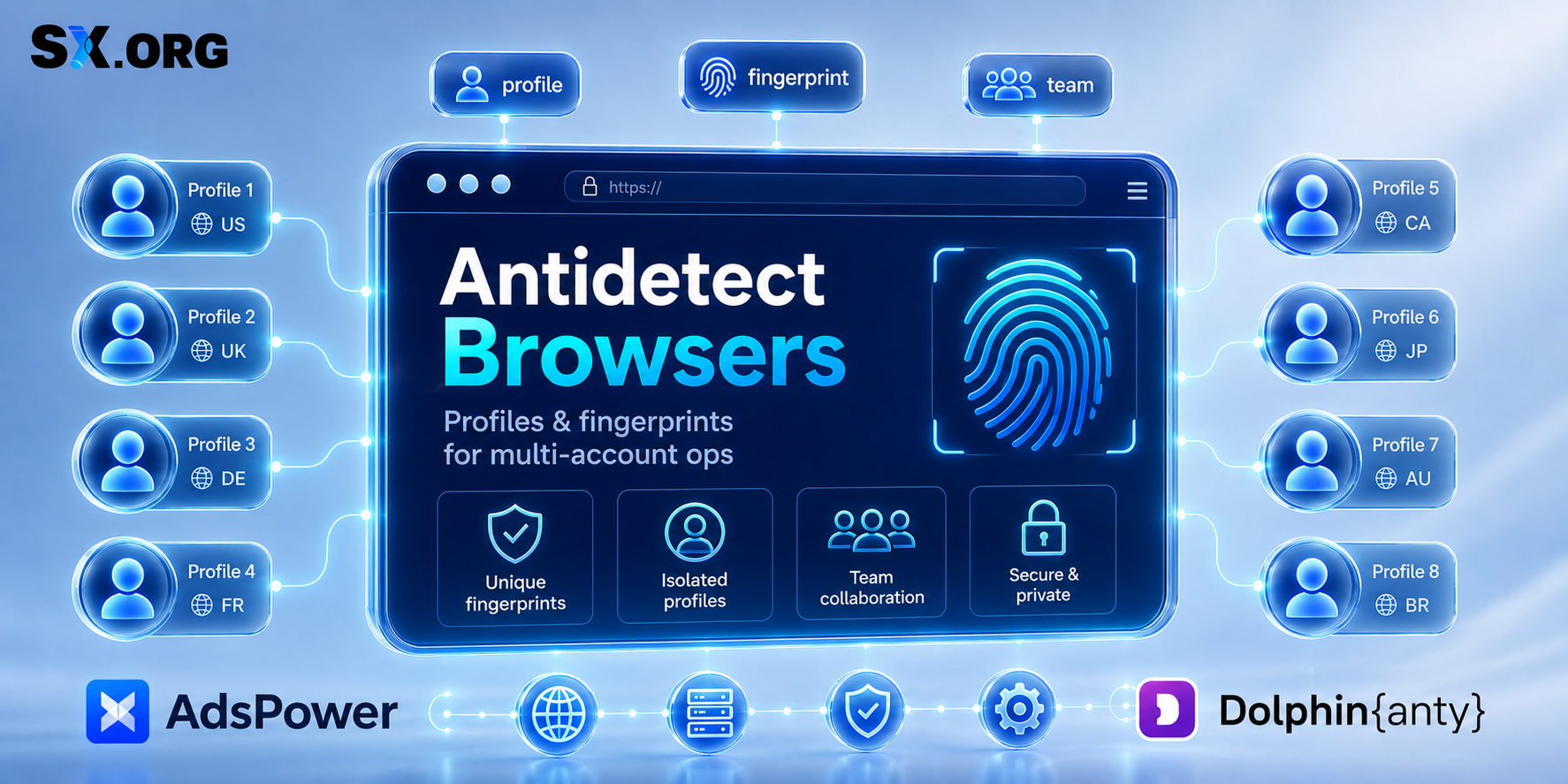
An antidetect browser is the core tool for multi‑account setups. It lets you create separate browser profiles with different fingerprints so accounts don’t link together and each profile looks like a different device.
AdsPower is one of the largest and most widely known antidetect browsers.
Why it works well for arbitrage:
- It lets you manage dozens or hundreds of profiles, each with its own fingerprint (canvas, WebGL, fonts, timezone, languages).
- It supports both Chromium‑ and Firefox‑based engines and offers granular fingerprint controls for different verticals.
- It includes built‑in automation features (local API, scenarios, RPA) to partially automate repetitive tasks.
AdsPower is a solid fit for both teams and solo media buyers who want a clear interface, profile scale and a reasonable balance between power and complexity.
Dolphin {Anty} is another antidetect browser that’s widely used by arbitrage teams and e‑commerce marketers.
What makes it interesting:
- Flexible profile management: groups, roles, notes, and extended logic for team workflows.
- Automation tools and integrations with external services, including SX.org proxies.
In practice, the “Dolphin {Anty} + SX.org” combo is common: the browser handles profiles and fingerprints, while SX.org provides clean IPs with the right GEO and network type.
Proxies: SX.org as Your IP Foundation
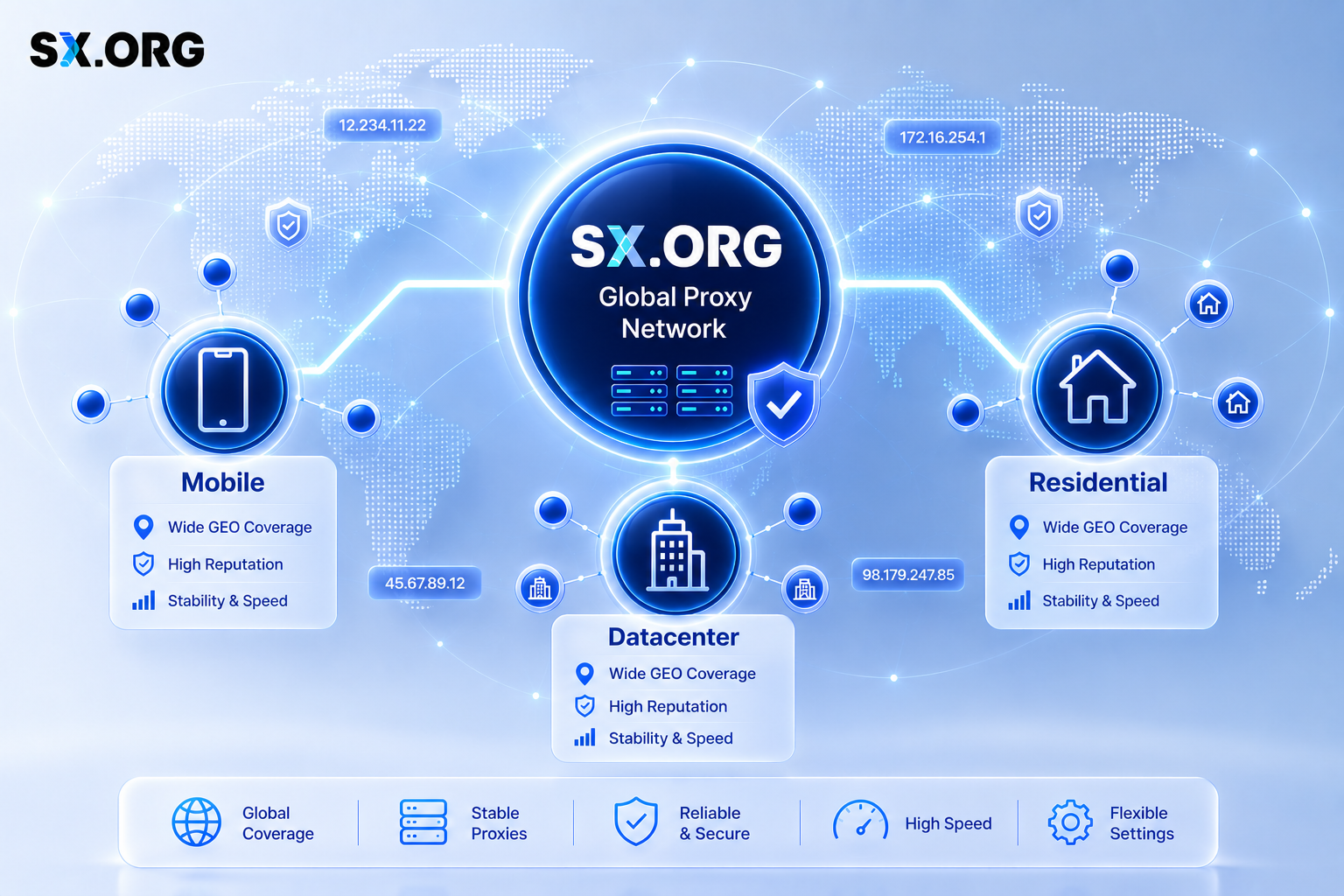
If the antidetect browser takes care of the browser fingerprint, proxies handle the network footprint. Platforms rely heavily on IP to decide whether your traffic looks like a real user or an automated farm.
A good proxy pool gives you:
- clear and consistent GEO and network type;
- stable latency without constant drops;
- reasonable IP reputation;
- fewer CAPTCHAs, extra checks and hidden restrictions.
In other words, proxy quality directly affects how long your accounts survive and how calmly you can scale your campaigns.
SX.org is not just a proxy provider; it’s a full proxy marketplace with its own pool of more than 12M clean IP addresses across all types.
Why SX.org makes sense in an affiliate stack:
-
You get mobile, residential and corporate IPs in one place, sourced from vetted partners and SX.org’s own pool.
-
Flexible geotargeting lets you choose countries and cities to match offers, targeting and the behavior you want to emulate.
-
Quality control: IPs are checked for GEO, network type, reputation, availability and stability, which dramatically reduces the share of “dead” or toxic addresses.
-
Pay‑As‑You‑Go pricing: you pay for the traffic you actually use instead of being locked into rigid subscriptions - ideal when volumes go up and down.
You also don’t need a huge starting budget: new SX.org users can get 3GB of trial traffic by registering with the promo code BLOG. That’s enough to test different GEOs, IP types and rotation schemes without risking your main spend.
When you treat proxies as a managed IP foundation instead of a random list of addresses, you usually see a clear difference: fewer bans, less instability and more control over how your infrastructure looks to ad platforms.
Virtual Cards: FlexCard, e.PN and eCards
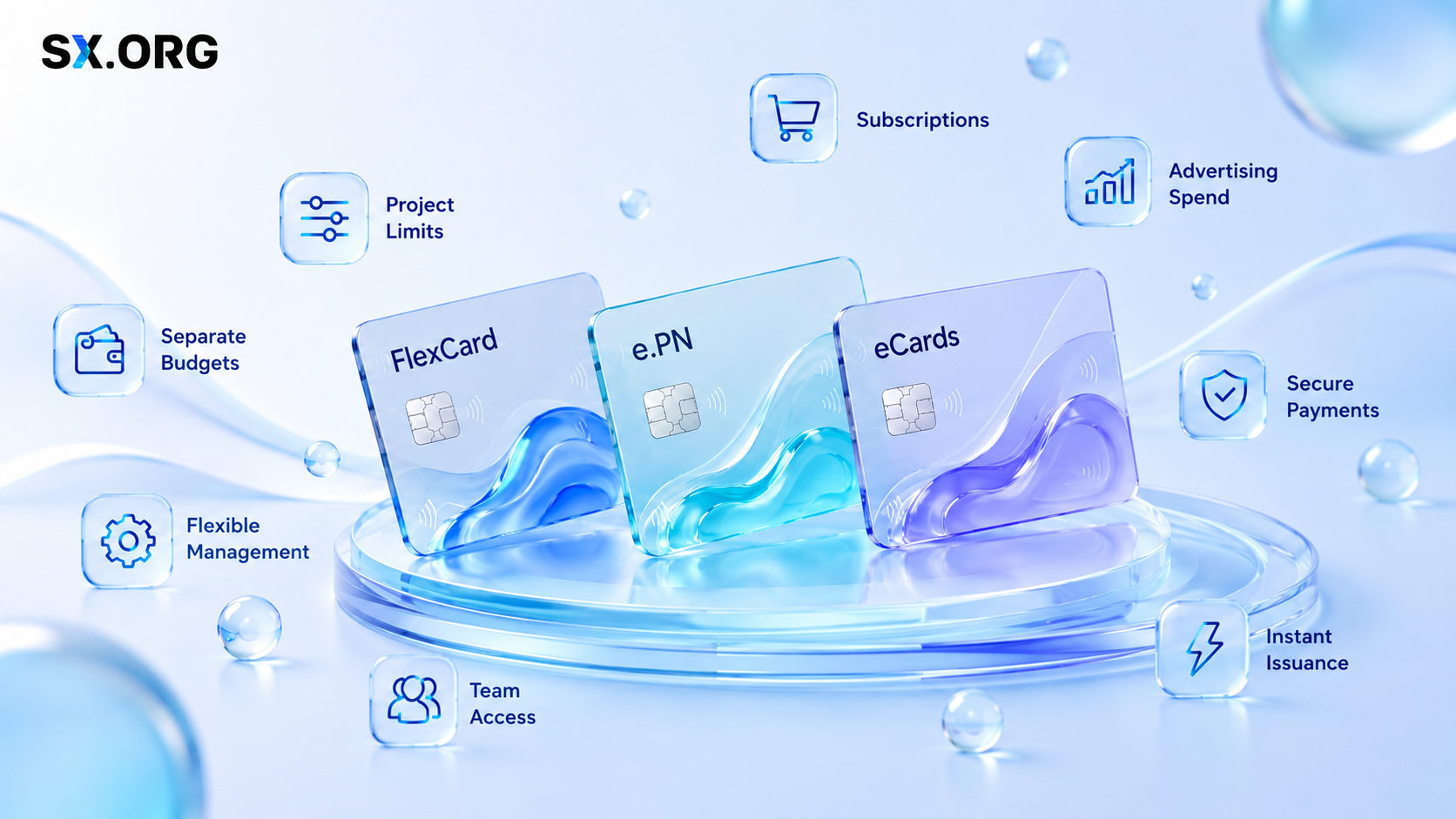
Virtual cards are the payment layer of the arbitrage stack. They help separate budgets by project, keep personal cards out of the workflow and reduce risk when a BIN, bank or payment provider starts producing declines.
FlexCard is a practical service for part of ad payments and digital subscriptions. It is used by media buyers and small teams that need a straightforward tool for recurring spending and separate cards for different tasks.
This setup is useful when you want to keep payments in a dedicated lane and avoid mixing operational budgets.
e.PN is a virtual card service for ad accounts, affiliate teams and recurring payments. It offers a large bank base, 3DS, support for different GEOs and a pricing model where the fee decreases as volume grows.
This setup works well when scalability, card separation by project and expense management within one ecosystem matter.
eCards can be used as an additional payment tool for ad spending and team workflows. It fits teams that need another dedicated lane for campaigns, tests and service payments.
That makes it easier to allocate budgets and keep different projects separated across cards.
From a practical standpoint, e.PN is a strong choice for teams and scaling, FlexCard is a good everyday option for ads and eCards is a backup and more niche tool.
IP Checkers: i.pn to See What Websites See
Before launching ads or logging into sensitive accounts, you need to know not only whether a proxy connects but also how the IP looks from the outside.
i.pn is a handy IP checker that shows:
- country and city;
- ISP, organization and ASN;
- IP type (mobile, residential, corporate);
- proxy/hosting flags and mobile network indicators;
- whether the IP appears in common blacklist databases.
For an affiliate marketer, i.pn is a quick way to:
- confirm that GEO matches what you ordered;
- ensure a mobile/residential IP didn’t turn out to be a datacenter address;
- assess basic IP reputation before running campaigns or new accounts through it.
Proxy Checkers: Checker.net as a Technical Filter
An IP checker shows the picture from a website’s perspective. A proxy checker evaluates the technical health of the proxy endpoint itself.
Checker.net is an online tool for technical proxy testing. It helps you:
- verify that the IP is actually working;
- check whether the required protocols (HTTP/HTTPS/SOCKS5) are supported;
- measure response time and stability;
- see if key sites and services are reachable;
- get an overall quality rating for each proxy.
The workflow is simple: before pushing large volumes of traffic through a pool or connecting important accounts, run your proxies through Checker.net and i.pn to weed out unstable, toxic or unsuitable IPs.
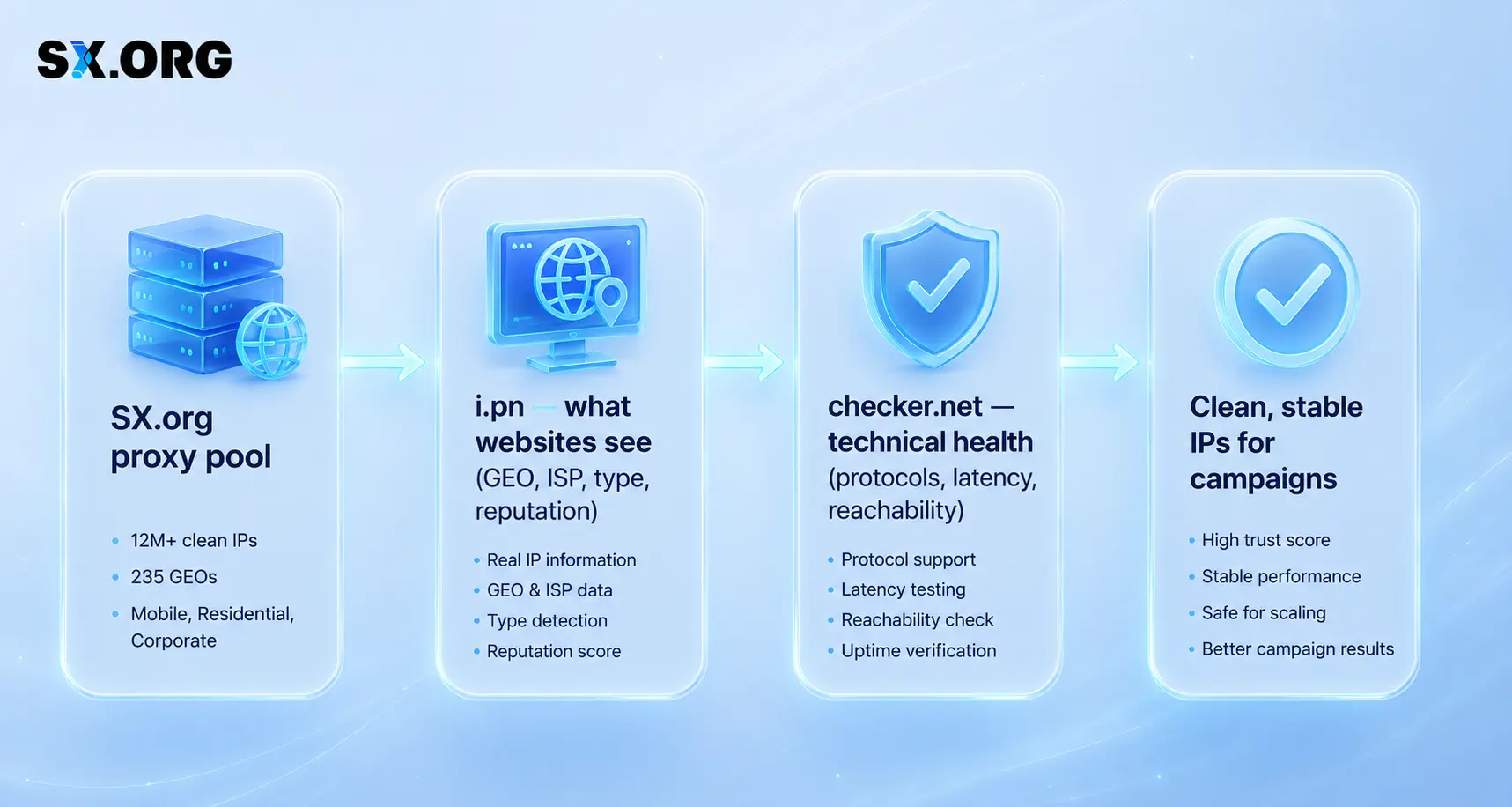
Combined, this trio gives you:
- SX.org for the actual proxy pool;
- i.pn to see how IPs resolve and look externally;
- Checker.net to validate the technical side of the connection.
Trackers and Analytics: Without Them, Arbitrage Is Guesswork
A tracker is the analytical core of your arbitrage operation. You don’t use it for decoration - you use it to know which funnels actually make money and which are just burning budget.
A good tracker helps you:
- calculate ROI for campaigns and offers;
- break down traffic by sources;
- see weak spots in your funnel;
- filter out low‑quality or fraudulent traffic.
Media buyers often use tools like Voluum, Binom and other dedicated trackers. The exact name matters less than the fit: it needs to plug into your funnel and workflows cleanly.
Ad‑Spy and Automation: TYVER and ZennoPoster
Beyond the core stack, media buyers benefit from tools that help find winning ideas faster and scale routine tasks.
TYVER is an ad‑spy tool that helps you analyze the market and see what already works for competitors.
It’s useful for:
- searching live ads by country, format and vertical;
- studying creatives, offers and approaches;
- discovering test ideas more quickly;
- eliminating weak hypotheses before you spend on them.
In practice, TYVER saves time on manual market research and gives you a clearer view of which funnels are actually being pushed in your niche.
ZennoPoster is an automation tool designed to scale repeatable actions.
It helps with:
- account registration and warming;
- automating routine browser workflows;
- data scraping for offers, prices, reviews and more;
- any repetitive scenario that you don’t want to handle manually.
Put simply, TYVER helps you decide what to launch, while ZennoPoster helps you do it faster and at greater scale.
Additional Technical Tools
On top of the core stack, it’s smart to add a few supportive layers:
- infrastructure monitoring (errors, response time, unstable GEOs);
- alerts for traffic and payment anomalies;
- landing page and redirect checks for policy compliance;
- basic anti‑fraud controls;
- landing page builders to quickly test new funnels.
These aren’t strictly “mandatory,” but they are what separate chaotic launches from systematic, repeatable operations.
Mini Checklist: What a 2026 Affiliate Stack Looks Like
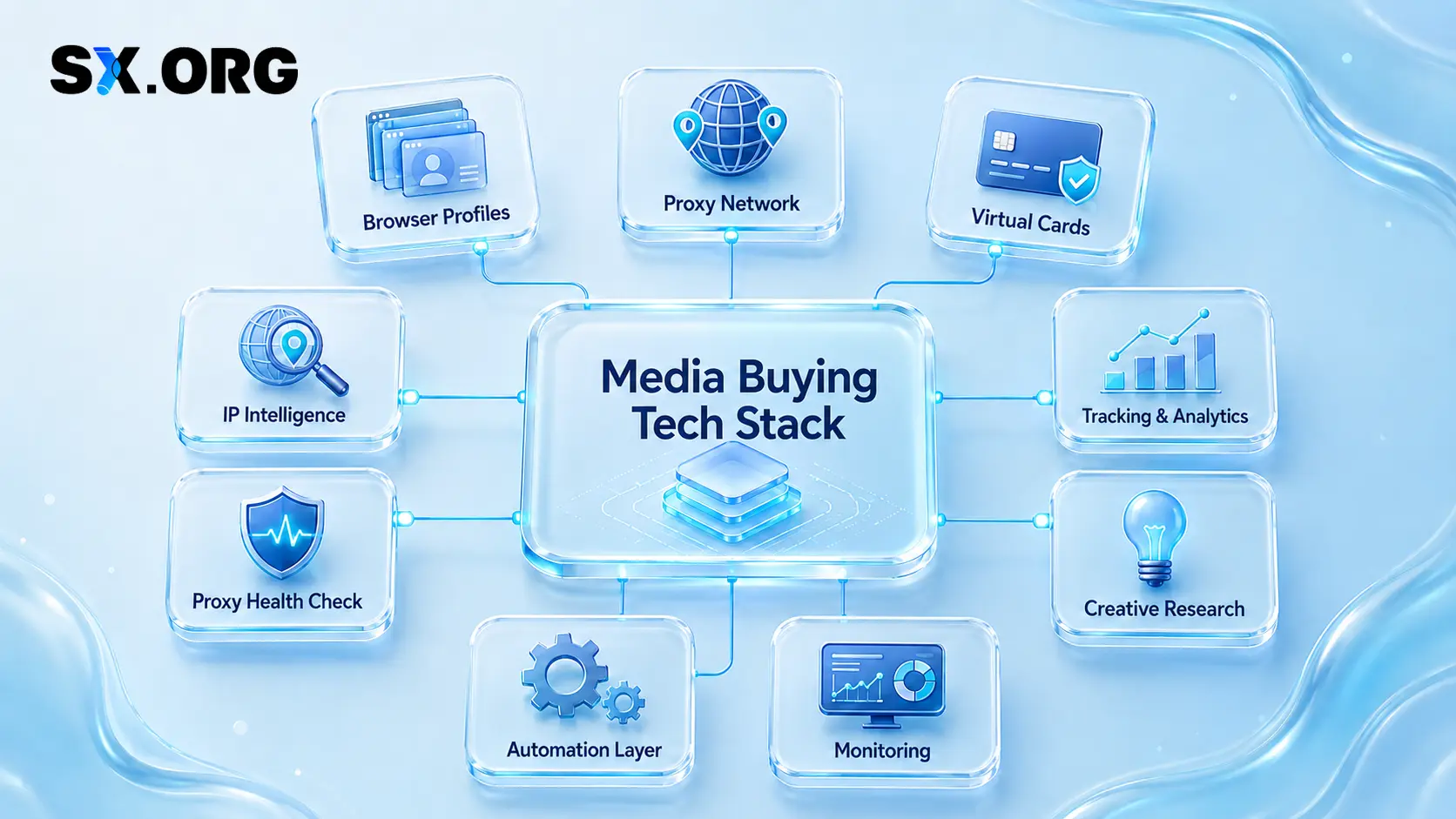
Putting it all together, a modern arbitrage stack in 2026 typically includes:
-
Antidetect browsers: AdsPower and Dolphin {Anty} for multi‑account management, profile control and team workflows.
-
Proxies: SX.org as a single source of mobile, residential and corporate IPs, with GEO, network type, reputation and stability checks - plus 3 GB of trial traffic with promo code BLOG for new users.
-
Virtual cards: FlexCard, e.PN and eCards to handle ad spend, subscriptions and tools with separate cards per project and clear limits.
-
IP checker: i.pn to see how your IP looks to websites and services.
-
Proxy checker: checker.net as a technical filter for protocol support, latency and availability.
-
Tracker: a dedicated tracking platform like Voluum or Binom to manage funnels, budgets and traffic quality.
-
Ad‑spy tool: TYVER for market intelligence, winning creatives and funnel discovery.
-
Automation: ZennoPoster for scaling routine tasks, registrations, warming, scraping and repetitive workflows.
-
Monitoring and anti‑fraud: a basic layer of alerts and checks so you learn about problems before they become bans.
This list isn’t meant to be the only “right” stack, but it gives a clear structure: which tools matter, how they fit together and which SX.org partners make sense to include if you want to build a stable, scalable arbitrage setup instead of just running one‑off tests.