
SOCKS5 Proxies: What They Are and How to Choose Them for Media Buying and Web Scraping
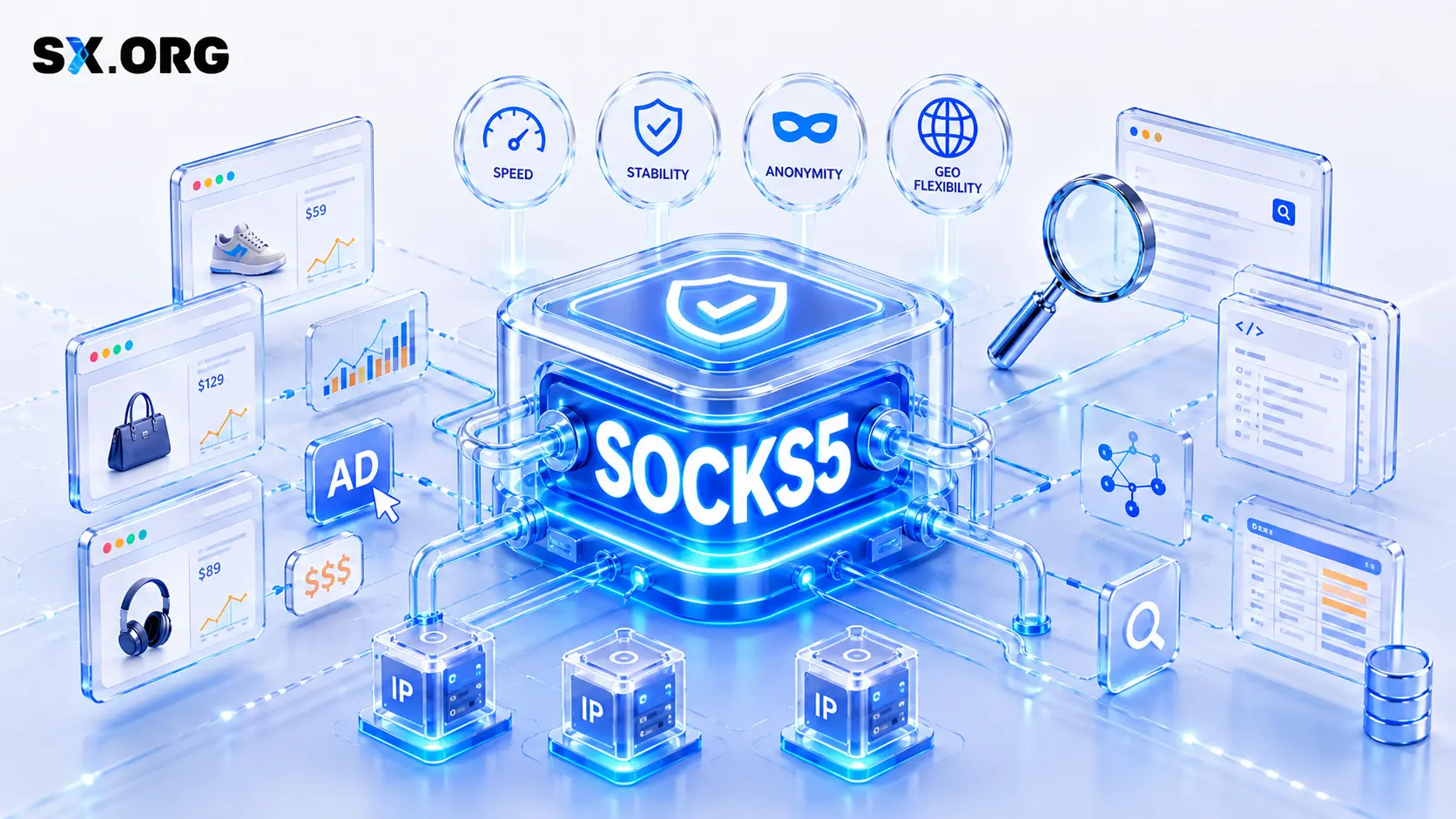
SOCKS5 is a versatile proxy protocol that routes internet traffic through an intermediary server. It works with browsers, anti-detect browsers, scrapers, scripts and other applications that support proxy connections.
For media buying, SEO, ad monitoring, and web scraping, SOCKS5 is valued for its flexibility. It is not limited to standard web traffic, supports authentication, and allows users to connect through IP addresses in specific countries, regions and cities.
What Is a SOCKS5 Proxy?
SOCKS5 is the fifth version of the SOCKS protocol. It allows an application to connect to websites and online services through a proxy server. Rather than connecting directly to the target resource, traffic first passes through the proxy, so the website sees the proxy IP address instead of the user’s original IP.
Unlike HTTP proxies, SOCKS5 is not restricted to HTTP requests. It can handle TCP and UDP connections, making it compatible with a wider variety of tools and workflows, including browsers, anti-detect solutions, bots, scrapers, applications and automation software.
It is important to note that SOCKS5 does not encrypt traffic on its own. It changes the route of a connection and the visible IP address, but it does not replace HTTPS, a VPN or other data-security tools.
SOCKS5 vs. HTTP Proxies
| Feature | SOCKS5 | HTTP/HTTPS Proxy |
|---|---|---|
| Traffic type | TCP and UDP | HTTP and HTTPS |
| Compatibility | Browsers, applications, scrapers, anti-detect browsers, scripts | Browsers, APIs, and web scrapers |
| Flexibility | High | Primarily intended for web traffic |
| Authentication | Supported | Supported |
| Application support | Compatible with many types of software | Depends on HTTP-proxy support in the software |
| Best for | Versatile connections and applications that require SOCKS5 | Standard web requests and browser-based tasks |
If your tool supports both protocols, the best option depends on the task. HTTP(S) proxies are often sufficient for straightforward web requests, while SOCKS5 is generally the better fit when you use specialised software, non-standard traffic or an application that explicitly requires SOCKS5.
Types of SOCKS5 Proxies
Before you buy SOCKS5 proxies, it is important to choose the right type of IP address. The protocol defines how the connection works, while the origin of the IP affects speed, stability, cost and how the destination website may treat the traffic.
Residential SOCKS5 Proxies
Residential proxies use IP addresses associated with home internet service providers. To websites, they generally appear similar to regular household connections. They are one of the most flexible options when you need broad geo-targeting and IP rotation.
Residential SOCKS5 proxies are commonly used for:
- Scraping public data, product pages and online catalogs
- Monitoring prices and inventory across marketplaces
- Conducting SEO checks and reviewing search results by location
- Verifying how ads and content appear in different markets
- Collecting publicly available data for research
For high-volume scraping, rotating residential proxies are often the most practical choice. The IP address can change at a selected interval or between requests, helping distribute traffic across multiple addresses.
Mobile SOCKS5 Proxies
Mobile proxies route traffic through IP addresses assigned by mobile operators. They can be useful when you need a mobile network footprint, location-specific testing or a stable session environment.
Mobile SOCKS5 proxies may be used for:
- Testing mobile versions of websites and applications
- Reviewing ads and landing pages for mobile traffic
- Checking location-specific content
- Working with platforms that are sensitive to IP reputation
- Workflows that require one IP address to remain consistent during a session
For longer sessions, sticky connections are often preferable. They keep the same IP address for a chosen period, reducing the likelihood of sudden network-environment changes while a session is active.
Datacenter SOCKS5 Proxies
Datacenter proxies are hosted on servers in data centers. Their main advantages are speed, consistent connectivity and usually a lower price than residential or mobile IPs.
They can be suitable for:
- Testing websites and APIs
- Collecting public data from resources with less restrictive access controls
- Developing and debugging scripts
- Technical monitoring
- High-speed workflows with substantial concurrency
However, some websites and platforms apply stricter controls to datacenter IP ranges. If the target service is sensitive to IP origin, it is worth testing residential or mobile proxies instead.
How to Choose SOCKS5 Proxies for Web Scraping
Web scraping requires a balance of request volume, speed, rotation, location targeting and connection stability. Even a large IP pool will not solve the problem if requests are sent too aggressively or the proxy configuration does not match the target website’s behavior.
Before buying SOCKS5 proxies for scraping, consider the following factors:
- IP type. Rotating residential proxies are often suitable for websites, marketplaces, and search engines. Datacenter proxies can be tested for technical sources.
- IP rotation. Use automatic rotation for a large number of independent requests. If your scraper follows a sequence of actions within one session, choose a sticky connection instead.
- Geo-targeting. Choose a country, region, city or ASN that corresponds to the market whose data you need. For example, use Spanish IPs to monitor prices in Spain or IPs from a specific city to review local search results.
- Concurrent connections. Check the provider’s limits for threads, ports and simultaneous connections. This is particularly important for high-volume data collection and team-based workflows.
- Authentication. The two most common methods are username-and-password authentication and IP whitelisting. Username and password are convenient when connecting from different devices, while whitelisting is often better for fixed servers.
- Usage statistics and traffic control. It is useful to see how much traffic each project, source or team member consumes. This helps you control costs and identify inefficient processes.
- Support and documentation. Scraping projects can involve connection errors, authentication issues or compatibility problems with specific tools. Responsive support and clear documentation can save significant time.
Web Scraping Configuration Example
Suppose you need to collect product prices and availability data from US e-commerce websites every day.
For this workflow, you could use rotating residential SOCKS5 proxies targeted to the United States. Start with a moderate number of concurrent requests and add intervals between them. Configure IP rotation by time or after a set number of requests, and include retry logic for temporary errors.
If the website returns CAPTCHAs, 403 responses or 429 rate-limit errors, do not immediately increase the number of IPs. First, reduce the request rate and review headers, cookies, session flow and retry behavior. Proxies are only one part of a reliable data-collection workflow.
How to Choose SOCKS5 Proxies for Media Buying
In media buying, speed and cost are not the only considerations. A consistent work environment is equally important. Your proxy setup should match the target geography and remain stable while you work with advertising accounts, analytics tools, landing pages and browser profiles.
When choosing SOCKS5 proxies for media buying, consider the following:
- Geo consistency. The country and region of the IP should match the campaign settings, language, target audience and wider working environment.
- IP type. For tasks that depend on IP quality, teams often test mobile, or residential proxies. Datacenter proxies may work well for technical processes and less sensitive use cases.
- Sticky sessions. If you work within one browser profile or advertising account, keeping the same IP address for the duration of the session is generally preferable.
- Software compatibility. Before scaling, confirm that your anti-detect browser, scraper or business application supports SOCKS5 and your chosen authentication method.
- Workflow separation. Assign a separate proxy or session to each profile, geography or project. This keeps configurations organized and makes traffic usage easier to monitor.
- Platform compliance. Use proxies for permitted purposes, such as local testing, ad-preview verification, competitor monitoring, corporate-access security and other lawful business workflows.
Proxieses do not guarantee advertising-account approval or prevent platform restrictions. Ad platforms evaluate many other signals, including account history, payment methods, devices, browser profiles, campaign activity, creatives and compliance with platform policies.
What to Check Before Buying
When choosing a provider, do not focus only on the price per GB. Reliable private SOCKS5 proxies should match your requirements for location coverage, IP quality, speed, support and account management.
| Criterion | What to check | Why it matters |
|---|---|---|
| Proxy type | Residential, mobile or datacenter | Determines the balance of speed, stability and IP characteristics |
| SOCKS5 support | Compatibility with your browser, scraper or software | Helps prevent connection and configuration issues |
| Geographic coverage | Availability of required countries, cities and ASNs | Important for local data and market-specific campaigns |
| Rotation options | By time, request or sticky session | Lets you configure the connection for the workflow |
| Authentication | Username/password or IP whitelisting | Affects access control and setup convenience |
| Limits | Ports, threads, sessions and connections | Important for scaling operations |
| Usage statistics | Traffic consumption and billing history | Helps you manage spend |
| Support | Documentation, response times, setup assistance | Reduces downtime during implementation |
| Trial volume | Ability to start with a small package | Lets you test proxies against your actual target resources |
Where to Buy SOCKS5 Proxies
If you need SOCKS5 proxies for scraping, SEO, marketing analytics or other professional use cases, choose a provider with several IP types, transparent pricing, flexible rotation options and the geographic coverage your project requires.
SX.ORG provides mobile andresidential proxies with SOCKS5 and HTTP support. You can select a country, city and ASN; configure rotation by request or timer; use sticky sessions and connect using username-and-password authentication or IP whitelisting.
Before using SOCKS5 proxies at scale, run a small test. Connect the proxies to your scraper or browser, check access to target websites, confirm that the GEO is correct, measure connection quality and estimate actual traffic consumption. This approach makes it easier to select the right configuration while avoiding unnecessary costs.
Use promo code BLOG to get 3 GB of traffic for free.
FAQ
Which is better for web scraping: SOCKS5 or HTTP?
If your scraper supports both protocols, the best option depends on its architecture and the nature of the task. SOCKS5 is more versatile and compatible with a wider range of applications, while HTTP(S) proxies are often sufficient for standard web requests. In either case, IP quality, appropriate rotation and a reasonable request rate matter more than the protocol alone.
Can I buy private SOCKS5 proxies for a team?
Yes. For team use, choose a provider that lets you create multiple ports, manage access, use separate credentials and monitor traffic consumption. It is also helpful to assign proxies by project, team member and workflow from the start.
Do SOCKS5 proxies need rotation?
Rotation is usually useful for large-scale scraping because it distributes requests across multiple IP addresses. For long sessions that need continuity, use a static IP or a sticky connection instead.
Are SOCKS5 proxies secure?
SOCKS5 supports authentication but does not encrypt traffic on its own. Use secure HTTPS connections, strong passwords, IP-based access restrictions where appropriate and never share proxy credentials with unauthorized parties.
Are SOCKS5 proxies useful for SEO?
Yes. SOCKS5 proxies can be used to monitor search results in different regions, review local visibility, analyze pricing and competitors and collect publicly available data. For regular monitoring, select the appropriate GEO and keep request frequency within reasonable limits.