
Explicarea proxy-urilor SEO: Cum să colectați date de căutare specifice geografice

When you check your rankings from Rotterdam, you never see the same search results as a user in New York, Berlin or São Paulo. That’s why serious SEO teams rely on SEO proxies to collect clean, geo-specific search data instead of trusting whatever Google shows on their local laptop.
What are SEO proxies?
SEO proxies are proxy servers optimized for tasks like rank tracking, SERP scraping, technical audits and competitor research. They route your requests to search engines through IP addresses in specific countries or cities, so you see search results as real local users do.
Instead of sending thousands of queries from one IP (and getting blocked or heavily personalized results), you spread them across a pool of neutral IPs with proper geo-targeting. This helps avoid bans, captchas, and “noisy” data polluted by personalization, previous searches or your usual location.
Why geo-specific search data matters
Search engines now serve different SERPs depending on location, language, device and user history. For SEO, that means your keyword position in one place may look great, while in another region you barely appear on the first page.
Geo-specific data is crucial when you:
- Work on local SEO and need to see results for a specific city or neighborhood.
- Run international campaigns across multiple countries and languages.
- Monitor competitors that focus on certain regions or markets.
- Report to clients based in different locations and need to show “their” SERP, not yours.
Without geo-targeted proxies, your dashboards and rank trackers can mislead you with data that simply doesn’t match what real users in those markets actually see.
How SEO proxies work in practice
From a technical point of view, an SEO proxy acts as an intermediate server between your tool (rank tracker, scraper, browser) and the search engine. When your tool sends a request, it goes through the proxy first, which then forwards it to the search engine using its own IP and location.
A typical workflow looks like this:
- You choose proxy type (mobile, residential, corporate) and target geo (country, region, city).
- You plug the proxies into your SEO tool or custom script.
- You set rotation rules (how often IPs switch) and connection behavior (sticky vs rotating).
- You start collecting search data: positions, snippets, People Also Ask, ads, maps and more.
Because each request can go out from a different IP in the right region, your data stays more consistent and much harder to block.
Key use cases for SEO proxies
SEO proxies show their real value in a few very common scenarios.
-
Rank tracking at scale
For tools and agencies monitoring thousands of keywords across many locations, proxies help query search engines safely and repeatedly without triggering aggressive protections. -
Local SEO and map pack monitoring
If you care about how your business appears in a specific city or even neighborhood, you need IPs in that area to see realistic local search and map results. -
Competitor and SERP feature research
Proxies let you capture titles, descriptions, featured snippets, People Also Ask and other SERP elements as they appear to actual users in targeted regions. -
Technical audits and crawl checks
When you run crawlers or audit tools, proxies spread traffic across many IPs and locations, which keeps large scans from looking like suspicious bot activity.
Which proxy types work best for SEO?
Different proxy types handle SEO tasks differently, especially when it comes to data quality, stability and block resistance.
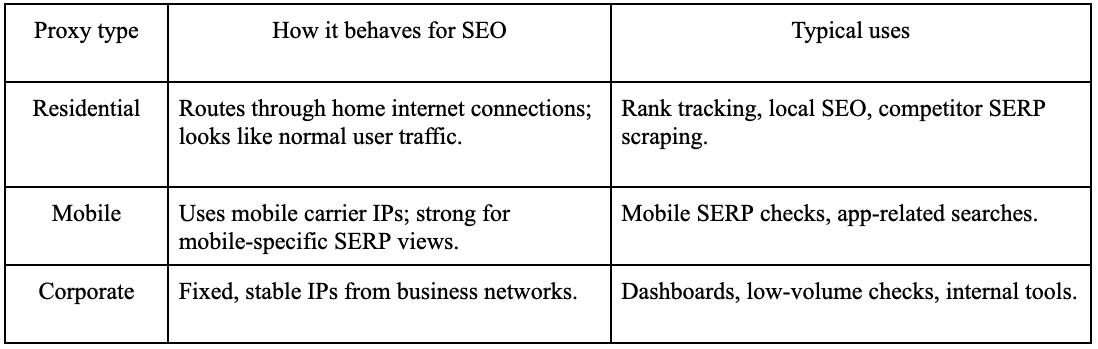
For most SEO teams, residential proxies are often the default choice because they look natural and handle rotation well, especially for local and international projects. Mobile proxies become important when mobile rankings and mobile-only features matter to your campaigns.
Best practices for collecting geo-specific SEO data
To keep your data clean and your proxy pool healthy, it’s worth following a few simple rules.
-
Validate IP geo regularly
Make sure the locations advertised by your provider match where the IPs actually resolve; this prevents “fake” local data. -
Rotate IPs intelligently
Rotate often enough to avoid bans, but not so aggressively that you lose session consistency when it’s needed. -
Limit requests per IP
Keep per-IP and per-minute limits within realistic ranges; this makes your traffic look like many normal users, not one aggressive bot. -
Separate projects by pools
Use different sub-pools of proxies for different clients, tools or regions so data streams don’t interfere with one another.
How SX.org helps with SEO proxies
SX.org provides mobile, residential and corporate proxies with precise geo-targeting, making it easier to plug the right IPs into your SEO stack. In the dashboard, you can create proxy ports for specific countries and cities, test connections and copy ready-to-use credentials into rank trackers, SEO tools or custom scrapers.
This setup allows you to:
- Collect unbiased, location-accurate search data.
- Monitor rankings and SERP features in multiple markets from a single interface.
- Scale audits, competitor checks and dashboards without constant IP issues.
When your SEO decisions depend on what users in specific regions actually see, SEO proxies stop being a “nice to have” and become a core part of your data pipeline